Tapping into human instinct for the age of intelligence.
Style Inference Labs is founded on a paradox of the age of AI. Though intelligence helped our quest for happiness as a human species when it partially liberated us from our instinct - which was repetitive, tunnel vision, unable to look beyond the immediate - happiness can only be instinctively felt, not thought. You can’t convince someone to be happy: this type of motivation, instinctive and therefore unresponsive to reasoning, has to come on its own. Intelligence alone cannot bring happiness and it needs its old foe, instinct, to collaborate.
Intelligence is oriented toward the future whereas instinct is rooted in the past. This gap between a person’s past and future experiences is important to evaluate. There is often a delay between the time we consciously realize the importance of an activity and the time we can unconsciously (without conscious effort) enjoy it. Why is it that we can’t just accelerate this cognitive process and muster up new motivation? Why can’t a new habit, clearly essential to our well-being, come natural to us at our instant will? Why can’t we simply convince ourselves that something new in our life is worth pursuing? We need answers to these questions related to our psychology as human beings because society is rapidly changing and an innovative future in which we can’t feel happy is not worth building.
The theoretical framework we propose to answer these questions is called style inference, a hybrid term descending from two distinct traditions: psychoanalysis and the philosophy of scientific inference. The two simple ideas borrowed from psychoanalysis which we believe the philosophy of scientific inference can help us safely operationalize are:
Human beings come with a finite quantity of attention and attachment, which Freud called the libido and which can be invested and re-invested in various places.
Desires which come naturally to us as well as those that don’t are only so because they are investments into a pre-existing psychological space or structure - which Freud called the Unconscious - with its own set of affordances and constraints unique to each person.
Why imagine such a space or structure to explain human desire? “I desire x because of qualities it has and which are visible to me,” goes the legitimate reply to Freud’s belief that his Unconscious, though invisible, exists and influences behavior. It is such disagreements that warrant a dialogue between psychoanalysts and historians or philosophers of science who understand the conditions in which it has been justified or even necessary to move beyond the observable world to accurately explain a natural or social phenomenon.
If this rapprochement between schools of thought can help refine Freud’s insight without betraying it and produce tangible results in improving mental health, then the theoretical implications and practical benefits of promoting it are important. If people can understand how their own desires are structured in any given context, they can better navigate a changing and dynamic environment which sometimes places before them potential objects of desire which their psyche technically cannot ‘afford’ to invest in. Instead of blaming themselves or others, people equipped with style inference would seek to understand why their desire didn’t emerge at any given moment, and which conditions permit it.
Ultimately, psychoanalysts insist the structure of desire, though rigid, can change: through a long-term quest of understanding, we can deeply learn that some of our desires are no longer viable, which compels our instinct to re-organize itself on its own, release the quantity of attention and attachment it placed on one object, and re-invest it elsewhere. This capacity to intelligently cultivate our own desires - without being able to control what new desires will grow out of our understanding - appears crucial to our individual and collective human future because it helps us invent a future still wired to our past and therefore still enjoyable.
The structure of desire: projective and introjective pathways
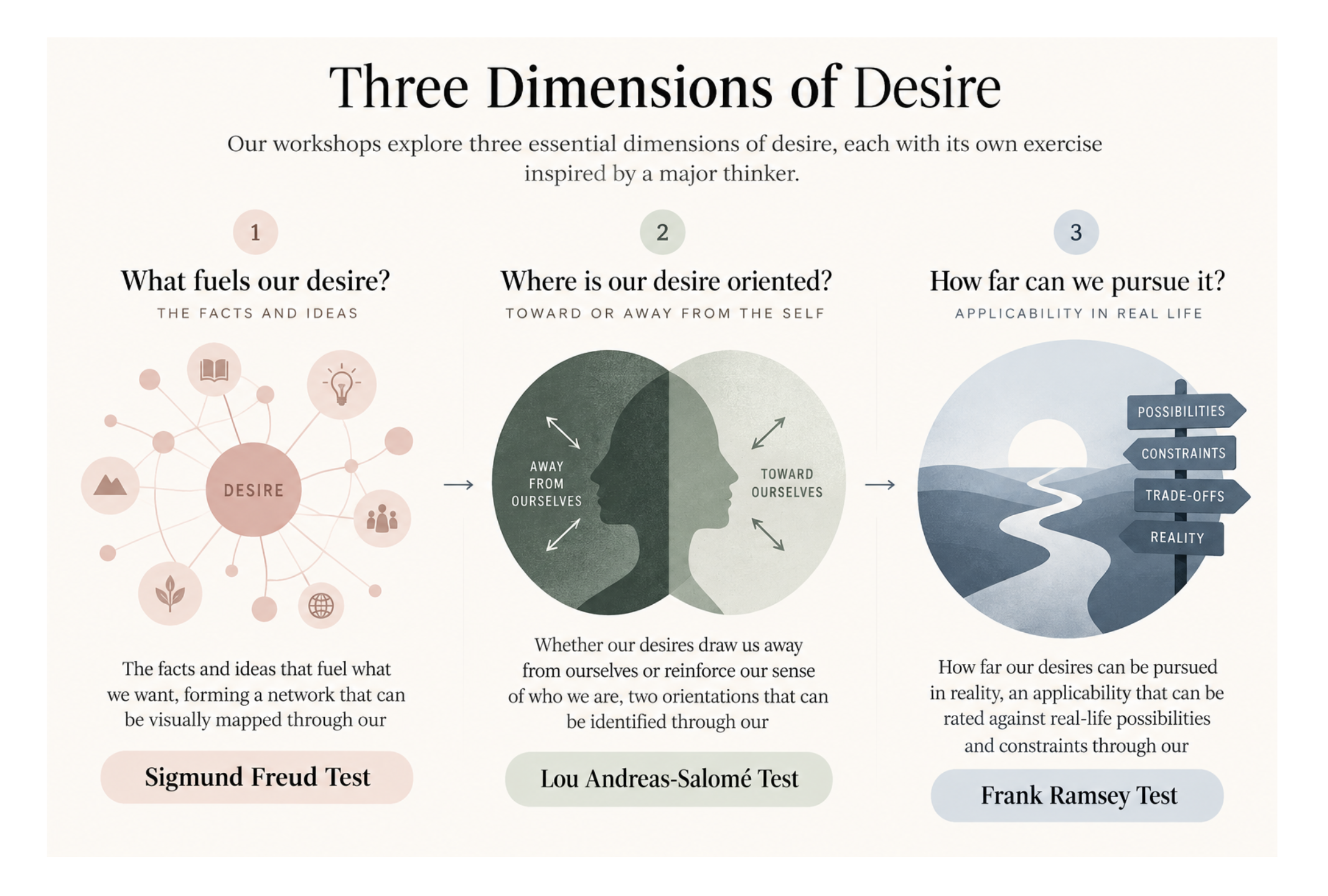
Style inference zooms into two specific mechanisms that explain why we feel naturally drawn to certain objects of desire: projection and introjection. Developed by Freud and Lou Andreas-Salomé, the first female psychoanalyst, both mechanisms have an immediate effect because they are fuelled by past desires we once let go but which are still on our mind, albeit unconsciously. Because these desires were abandoned but were once potent, they still lend their strength to something new we encounter in life and which now stands on their behalf.
This process of loss tied to a process of creation is detectable when we examine why we project (I instantly give meaning to x) or introject (x instantly gives me meaning) in a particular case. Many people do not feel motivated to study for an exam or push through their programming certification, nor go to work or hit up the gym. When we compare ourselves with people who feel instantly motivated to do any of these activities, style inference becomes useful. For Freud and Andreas-Salomé, the people for whom some desires do not come naturally are simply not projecting nor introjecting: they want x or y, sure, but only as an intelligent means to an end, a calculation of future value. The issue with the new activity they wish to pursue is that it is connected to neither their past nor to dreams and ambitions once blindly pursued till disillusionment. It is such secret and forgotten ‘tragedies’ - passions and ideals which a reality check wrestles away from our chest - that contribute to a new chance for us to love something as strongly again.
The cycle of motivation: seven steps
1. Identify a specific desire. Choose something you feel drawn to or motivated about. It can be a career goal you are pursuing, a hobby you like, a person you look up to or find attractive. It can be a guilty pleasure you don’t understand or an established taste you are open and proud about.
2. Measure effort. Ask yourself: does this desire feel calculated or instinctive? On one hand, desires can be conscious, part of a larger plan, goal, or strategy. On the other hand, desires can be unconscious, what we like without much thought or effort.
3. Gauge the axis. In the case of instinctive desires, ask yourself: am I giving something meaning or is it giving me meaning? The first suggests projection, an escape from ourselves toward something we perceive more lovable and important. The second suggests introjection, a return to ourselves, feeling loved or important.
4. Assess consequence. Ask yourself: is this desire inhibiting or empowering you or others? Reflect on (and ideally research) the ethical and pragmatic dimensions of this desire.
5. Trace origin. Dig into your past. Connect your present motivation with its buried predecessors, similar desires you outgrew and abandoned along the way. At first, they may appear unconnected to the motivation you’re reflecting on, but you may eventually see the connection.
6. Experience disillusionment. A genuine understanding will allow you to move on from inhibiting desires and maintain empowering ones. Once you reach this stage, your instinct re-organizes itself without your conscious input: it takes into account the new facts uncovered and re-prioritizes what you should instantly desire.
7. Wait. In due course, you will feel newly motivated. About what? You can’t predict it: you can only feel it. But on that day, you will recognize where it came from. It will have been you who watered the soil in which you saw grew a new motivation, a new reason to get out of bed, a new way to feel immediately alive.
Ready to build motivation?
Fill the form below or get in touch with us via contact [at] styleinferencelabs.com